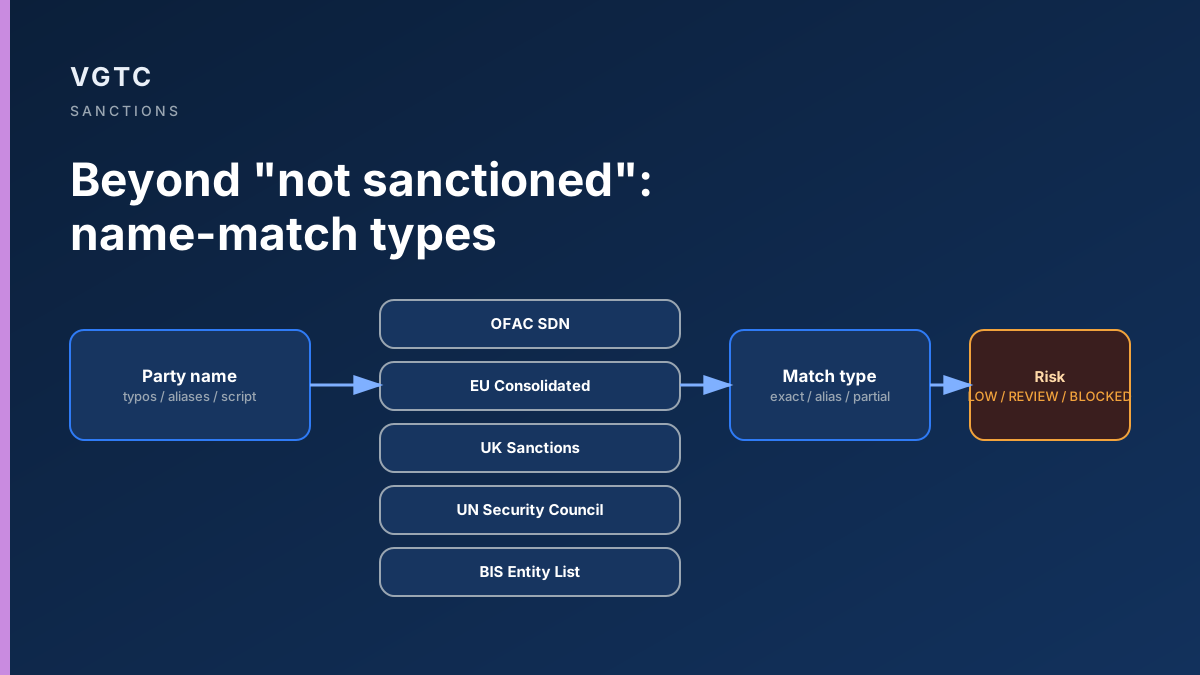
Why a Sanctions Name Match Does Not Automatically Mean a Party Is Sanctioned
Screening tools return name matches, not verdicts. How to read SDN entries, why identifiers — not names — decide the outcome, and a defensible triage process for possible matches.
"Your counterparty matched the SDN list." Few sentences in trade operations cause more panic. Yet most screening hits are exactly what the industry calls them: false positives. Common surnames, transliterated Cyrillic or Chinese characters, shared company wordmarks — none of these make a party sanctioned. What decides the outcome is whether identifying details line up.
Names alone were never the test
Open any SDN entry on OFAC's site and you will find far more than a name: dates and places of birth for individuals, registration numbers, addresses for entities, vessel IMO numbers, passport details where available. The authorities publish these identifiers precisely because matching is supposed to happen at that level. OFAC even publishes guidance on weak-alias handling because alias-heavy entries generate predictable noise.
The EU's consolidated list and the UK's OFSI lists follow the same design principle: each listing carries identifiers that distinguish the target from everyone else who happens to share a name.
Why screening engines still flood you with hits
- Transliteration variance — one Cyrillic name has many Latin spellings, so fuzzy matching widens deliberately to avoid missing real targets.
- Phonetic algorithms — Soundex-style matching treats 'Mohammed', 'Muhammad' and 'Muhamed' alike, which is necessary and noisy at once.
- Corporate suffixes and geography — 'Gulf Trading LLC' collides with half a dozen unrelated firms across jurisdictions.
- Conservative thresholds — screening tools tune for recall (don't miss anyone) over precision, because the cost asymmetry favors noise.
In other words: your tool did its job by showing you the candidate. The job is only half done until a human resolves it.
A defensible triage process
- Freeze the transaction decision — do not proceed and do not reject yet; just stop moving while you assess.
- Compare identifiers, not strings: date/place of birth, nationality, passport/ID numbers, full addresses, IMO numbers against the listing entry as published.
- Check ownership rules — under OFAC's 50% Rule, entities owned 50% or more in aggregate by blocked persons are blocked even when unlisted. Ownership analysis can turn a 'clean' match result into a true concern.
- Document everything: which list version was screened, entry numbers compared, identifiers checked, conclusion and reviewer identity.
- Escalate genuine ambiguity to sanctions counsel before acting; if a true match is confirmed, blocking and reporting obligations follow the relevant regime's procedures.
What good tooling changes
- Address and identifier fields reduce noise at match time, cutting review volume without lowering recall.
- Transliteration-aware comparison catches variant spellings that naive exact-match systems miss in both directions.
- Version-stamped list data means you can always answer 'which list edition produced this result?' months later.
- A review workflow with approve/request-info/reject outcomes turns raw hits into an auditable record.
One caution cuts the other way too: absence of a match is not proof of cleanliness if your data quality is poor. Screening garbage-in produces false negatives, and false negatives are the dangerous kind. Invest in clean counterparty data — full legal names, addresses, registration identifiers — as much as in the matching engine itself.
Primary sources
- OFAC Sanctions List Service — SDN and Consolidated List data — US Department of the Treasury, accessed 2026-08-25
- Revised Guidance on Entities Owned by Blocked Persons (the '50% Rule') — US Department of the Treasury, OFAC, accessed 2026-08-25
- EU Consolidated Financial Sanctions List (Financial Sanctions Files) — European Commission, DG FISMA, accessed 2026-08-25
- UK Sanctions List / OFSI Consolidated List — HM Treasury, Office of Financial Sanctions Implementation, accessed 2026-08-25
Editorial review team. Educational content about screening practice; it is not sanctions legal advice. For an actual determination, consult sanctions counsel or the relevant authority.
Regulatory requirements change. Verify current rules with the relevant authority before relying on this material for a shipment. VGTC is decision-support software; nothing here is an official customs determination.
Apply this in VGTC
Sanctions Checker
Screen names against major sanctions lists and see match evidence side by side.
Related articles
Stay ahead of trade compliance changes
Get practical regulatory updates and VGTC product guidance. No spam — unsubscribe anytime.
Periodic practical updates on customs, HS classification, sanctions, CBAM and Vietnam trade. See our Privacy Policy. Unsubscribe anytime via the link in every issue.