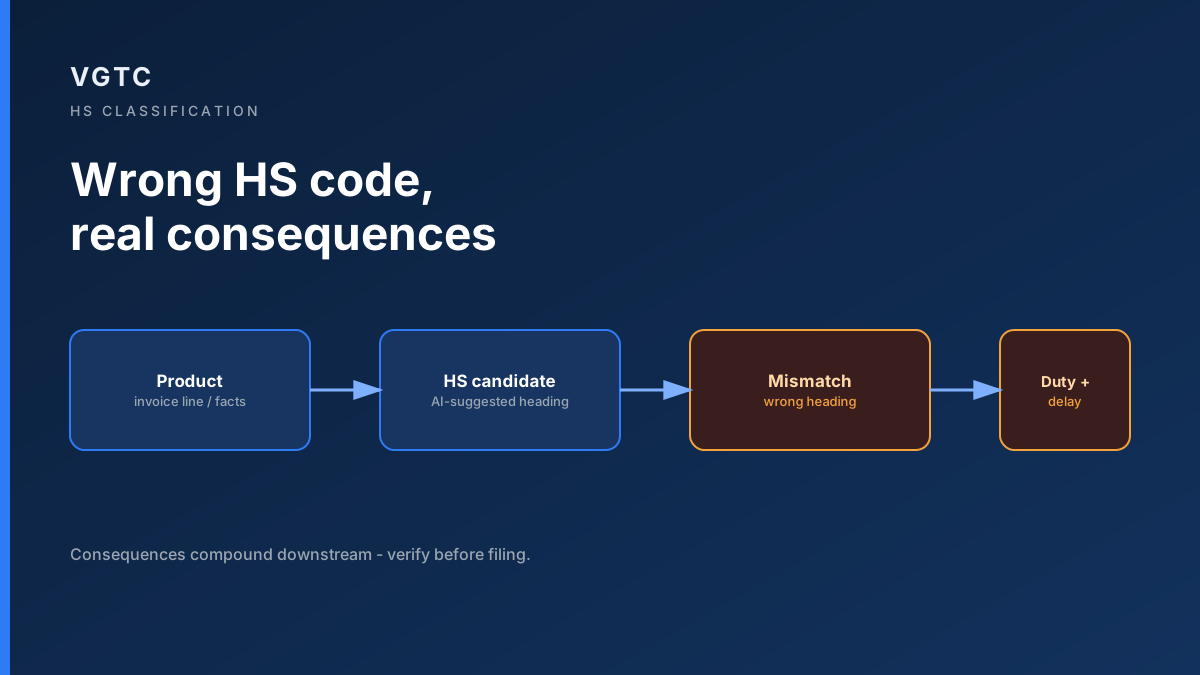
What Happens When You Use the Wrong HS Code?
Misclassification is one of the most common customs violations. Here is how US and EU authorities treat an incorrect HS code, what penalties can look like, and how to fix past errors before they become enforcement cases.
Most importers discover misclassification in one of two ways: a shipment gets held at the border, or — far worse — a customs authority opens a retrospective review of entries going back years. The second scenario costs more, because by then the error is not one declaration but a pattern.
This article explains how the two largest import markets treat a wrong classification code, in plain terms, with links to the actual legal provisions so you can read them yourself.
The duty itself is only part of the exposure
An incorrect code usually means the wrong duty rate was applied. If the rate you paid was too low, customs can recover the difference after import — in the United States under 19 U.S.C. §1504 (generally within five years of entry), and in the EU under recovery time-limits set by the Union Customs Code. The bill grows with interest or late-payment charges in many jurisdictions.
But the duty shortfall is rarely where the real risk sits. Classification errors are treated as violations of declaration accuracy, which brings penalties into play.
How the US treats it: negligence tiers under 19 U.S.C. §1592
US law distinguishes three levels of culpability when a violation occurs:
- Fraud — the error was intentional. Penalties can reach the domestic value of the merchandise.
- Gross negligence — you should have known. Penalties are calculated as the lesser of the domestic value or a multiple of the lawful duties that would have been owed.
- Negligence — ordinary failure to exercise reasonable care. Lower maximums apply, again tied to the lawful duties at stake.
"Reasonable care" is your defense — and your obligation
Under 19 U.S.C. §1484, the importer of record must use reasonable care to enter, classify, and value merchandise. In practice, reasonable care looks like: documenting how you chose the code, checking CBP's CROSS database for rulings on similar products, consulting the HTS chapter notes, and getting expert help when products sit between headings. Importers who can show this paper trail are in a categorically better position than those who simply accepted a supplier's code.
Recordkeeping matters too: entry records generally must be kept for five years from the date of entry under 19 U.S.C. §1508 and its implementing regulations. If you cannot reconstruct why a code was chosen, every old entry becomes harder to defend.
Outside the US
The EU enforces classification accuracy through the Union Customs Code framework: member states can recover underpaid duty and apply sanctions under national law implementing the UCC, and repeated errors invite increased controls. Vietnam and India run their own tariff schedules (8-digit AHTN and ITC(HS) respectively) with national penalty regimes. The principle is consistent everywhere: the declarant is responsible for accuracy.
A short prevention checklist
- Classify from technical specifications, not marketing descriptions.
- Work through the General Rules of Interpretation in order; GRI 1 first, GRI 3 only if GRI 1 fails.
- Search CROSS (US) or the EBTI database (EU) for precedent on similar goods.
- Verify the full national code — the 10-digit statistical suffix in the US changes reporting obligations even when duty does not change.
- Re-review classifications when regulations or product composition change.
- Keep evidence of your reasoning with each classification record.
VGTC's position: classification tooling should assist a qualified professional, not replace them. Our classifier shows its reasoning and confidence, flags low-confidence results for human review, and cites precedent rulings where they exist — because the person signing the declaration carries the responsibility.
Primary sources
- 19 U.S.C. §1592 — Penalties for fraud, gross negligence, negligence — US House of Representatives, Office of Law Revision Counsel, accessed 2026-08-25
- 19 U.S.C. §1484 — Entry of merchandise / reasonable care — US House of Representatives, Office of Law Revision Counsel, accessed 2026-08-25
- Mitigation guidelines for customs violations (19 CFR Part 171, Appendix B) — US Customs and Border Protection (eCFR), accessed 2026-08-25
- CROSS rulings database — US Customs and Border Protection, accessed 2026-08-25
Editorial review team. Articles are verified against the primary sources cited in-text and carry a review date. VGTC content is educational and is not an official customs determination.
Regulatory requirements change. Verify current rules with the relevant authority before relying on this material for a shipment. VGTC is decision-support software; nothing here is an official customs determination.
Apply this in VGTC
HS Finder
Look up HS codes with confidence signals and precedent-ruling references.
Related articles
Stay ahead of trade compliance changes
Get practical regulatory updates and VGTC product guidance. No spam — unsubscribe anytime.
Periodic practical updates on customs, HS classification, sanctions, CBAM and Vietnam trade. See our Privacy Policy. Unsubscribe anytime via the link in every issue.